
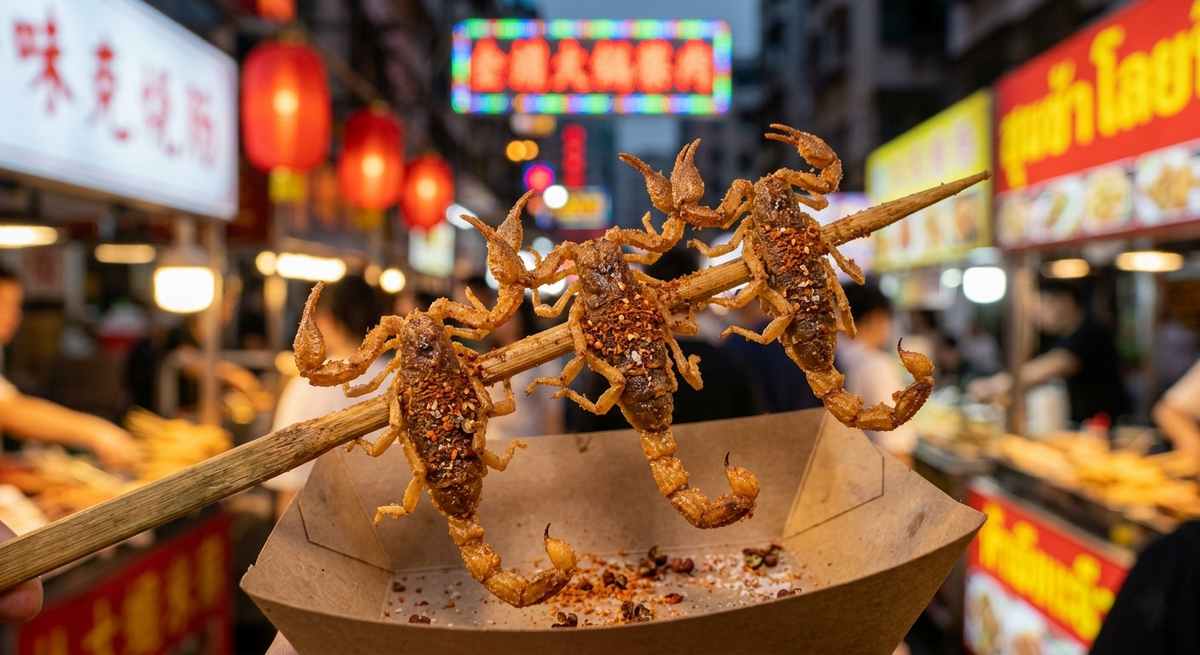
Imagine a scene straight out of a daredevil’s food fantasy. A vendor holds a skewer loaded with large, dark scorpions. Their barbed tails and pincers are still perfectly intact. Then, with a quick dip into bubbling oil, they turn into a crispy, golden-brown snack on a stick. This is Scorpion on a Stick — one of the world’s most exciting street foods. You’ll find it everywhere from the night markets of Beijing to the busy streets of Bangkok.
Wangfujing Snack Street in Beijing is the best place to find Scorpion on a Stick. Vendors hold bouquets of skewered scorpions arranged in dramatic sunburst patterns. Khao San Road in Bangkok is another prime location. There, you’ll also find crickets, grasshoppers, and giant water bugs.
The scorpions sold at night markets come from farms that raise them specifically for food — not from the wild. The high heat of deep-frying neutralizes their venom, making them safe to eat.
For example, if you’re interested in other extreme street foods, try fried tarantula in Cambodia or sannakji in South Korea.
Want to learn more about extreme Asian street food? Read National Geographic’s article on insect cuisine or explore BBC’s feature on Wangfujing snacks.
Key Insight: The taste is mild — mostly the oil and seasoning. The body is surprisingly soft inside (like soft-shell crab). The legs are incredibly crispy (like a crunchy chip). You’re paying for the experience and the story.
Where to Eat Scorpion on a Stick
Beijing (Wangfujing Snack Street): Dongcheng District. Best time to go is evening (6pm-10pm). A skewer costs ¥30-60 ($4-8 USD). It’s near Wangfujing shopping street, about a 15-minute walk from the Forbidden City.
Bangkok (Khao San Road): Banglamphu area. Visit in the evening (7pm-midnight). Price: ฿100-200 per skewer ($3-6 USD). It’s near Wat Phra Kaew and the Grand Palace (15-minute walk).
Other locations (less common): Phuket (Bangla Road), Chiang Mai (Saturday/Sunday Night Markets), Hong Kong (Temple Street Night Market — seasonal), and Taipei (Shilin Night Market — more crickets, fewer scorpions).
For other insect-based extreme foods, read about escamoles (Mexican ant eggs).

Wangfujing Snack Street in Beijing — the best place for scorpion on a stick.
Is Scorpion on a Stick Safe to Eat?
Yes, it is safe when prepared properly. Deep-frying (high heat) removes scorpion venom, making it harmless. Frying also kills bacteria and parasites.
However, scorpions are arthropods. Therefore, people with shellfish allergies may have a reaction.
Safety tips: Only buy from busy vendors with high turnover (the scorpions will be fresher). Make sure the scorpions are fully submerged in hot oil.
Tips for First-Timers
- Take the photo before you eat — once fried, it looks less dramatic
- Choose a busy vendor
- Don’t overthink it
- Pair it with a drink (beer or soda)
- Share with friends — half the fun is watching their reactions
- Start with the legs (the crispiest part) and chew thoroughly
- Don’t try to swallow it whole
For more information on edible insects and food safety, check out WHO’s food safety guidelines.
Key Takeaways:
• Scorpion on a stick is deep-fried Asian forest scorpions — famous in Beijing (Wangfujing) and Bangkok (Khao San Road)
• Price: ¥30-60 ($4-8 USD) in Beijing, ฿100-200 ($3-6 USD) in Bangkok
• Taste: mild — mostly oil and seasoning; body soft (like soft-shell crab), legs crispy
• Deep-frying neutralizes the venom — safe to eat from reputable vendors
• People with shellfish allergies may react (scorpions are arthropods)
• Adventurous tourists eat this most often — locals prefer crickets and grasshoppers
Ready to Take the Scorpion Challenge?
Follow EatSleepPush for more extreme food guides from around the world.