

A-Ping being prepared in a hot wok — Cambodia’s most infamous street food.
The sizzle of oil, garlic, and the sight of large, hairy legs curling in a hot wok — this is not your average street food scene. In Cambodia, one of the most famous culinary exports is also its most extreme: the Fried Tarantula (A-Ping). This eight-legged snack is more than a shock factor; it is a symbol of survival, resilience, and a unique part of the country’s food culture.
The history of eating tarantulas dates back to the brutal Khmer Rouge regime (1975-1979), when famine drove people to forage for survival. What began as desperation evolved into a cultural staple. Today, it stands as an edible monument to the resilience of the Cambodian people.
For those seeking other extreme delicacies, you might also try sannakji in South Korea or scorpion on a stick in Bangkok.
Want to learn more about this Cambodian delicacy? Read National Geographic’s article on fried tarantulas or explore BBC’s feature on A-Ping.
Key Insight: The taste is not overwhelmingly “spidery” — the body resembles crab or soft-shell crab, while the legs are incredibly crispy like a potato chip.
Taste, Texture, and Where to Find It
Many describe the flavor as reminiscent of crab, with garlic and salt dominating the palate. The abdomen has a creamy, gooey texture (like a runny egg yolk), while the legs are crunchy. The true home of this dish is Skuon (“Spiderville”), 75 km north of Phnom Penh. Prices range from $0.50 to $1.50 per tarantula.
Similar to how other cultures have adopted balut in the Philippines as a symbol of local identity, fried tarantula represents Cambodian resilience.
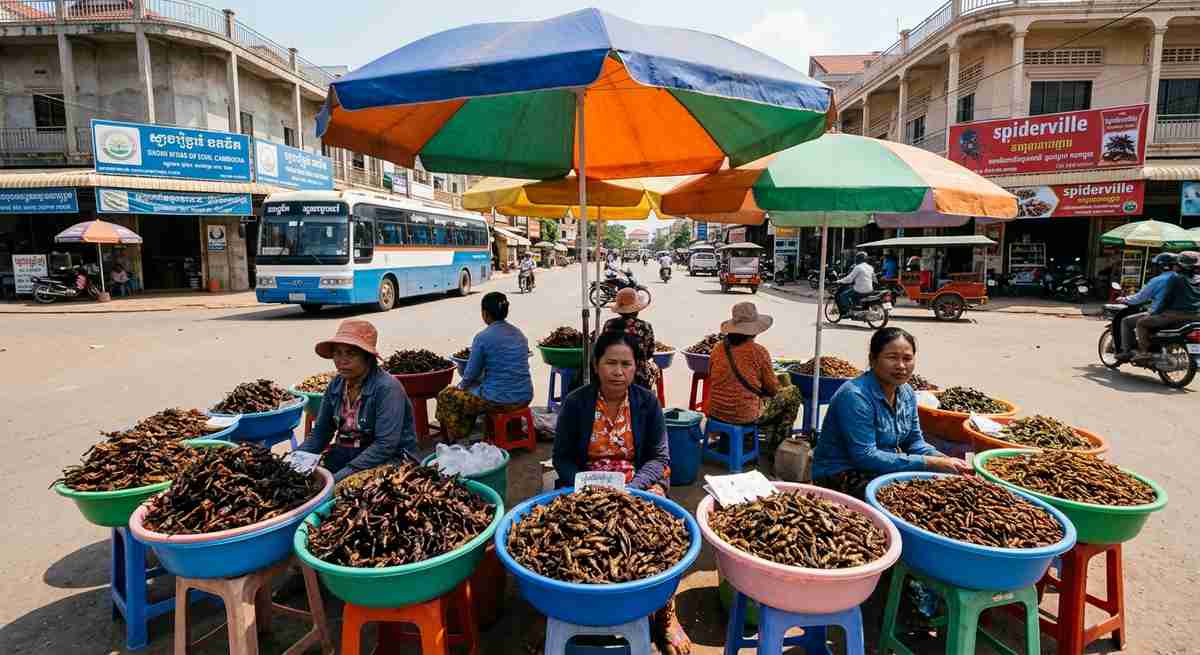
Skuon, Cambodia — “Spiderville” — the epicenter of fried tarantula street food.
Nutrition and Ethical Considerations
Fried tarantula is surprisingly nutritious, packed with protein, zinc, and folic acid. However, as popularity grows, sustainability concerns arise. When seeking this snack, buy from local vendors in Skuon who source spiders sustainably, supporting the local economy directly.
For more information on edible insects and food safety, check out WHO’s food safety guidelines.
Key Takeaways:
• Fried tarantula (A-Ping) originated from survival during the Khmer Rouge era
• Tastes like crab with a creamy abdomen and crunchy legs
• Found in Skuon (“Spiderville”) for $0.50-$1.50 each
• Packed with protein; buy from local vendors for ethical sourcing
Ready for Extreme Food Adventures?
Follow EatSleepPush for more guides on balut, sannakji, and scorpion on a stick.