
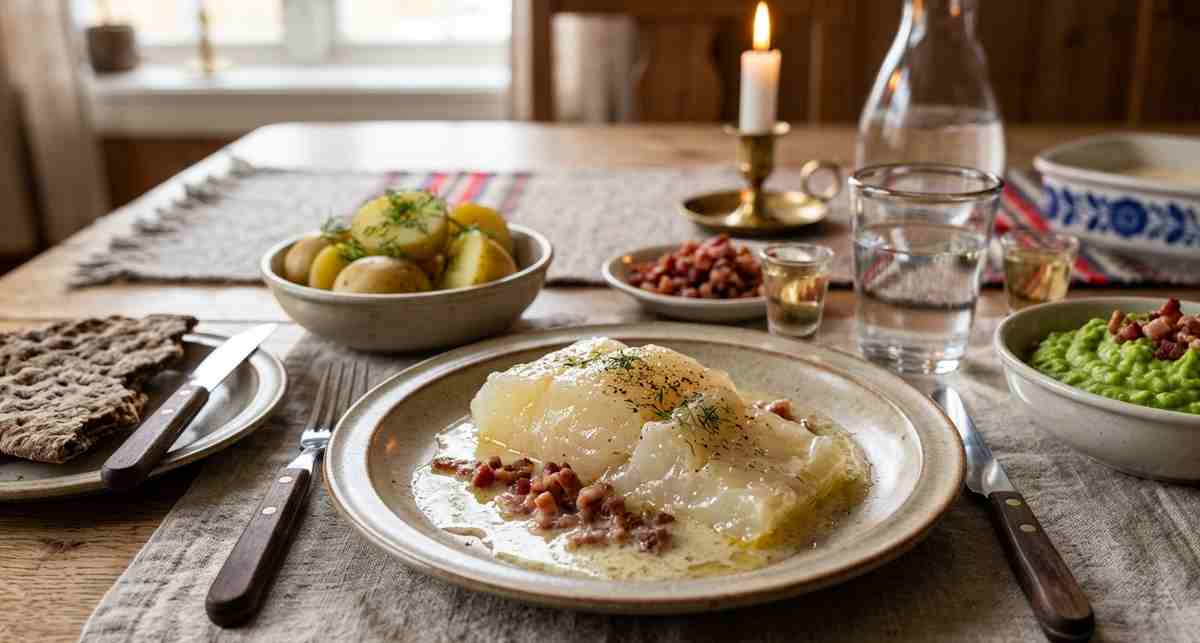
Lutefisk Minnesota represents one of America’s most unusual immigrant food traditions. Norwegian immigrants brought this dish to the United States many years ago. They carried their love for this strange fish dish across the ocean. Today, lutefisk Minnesota remains a beloved winter tradition for Scandinavian-American families. This translucent, jelly-like fish dish may look strange. But for many, it tastes like home and heritage.
So what exactly is lutefisk? Makers start with dried whitefish, usually cod or ling. First, they soak the fish in cold water for several days. Then, they soak it in a solution of lye (a strong alkaline chemical). This step gives lutefisk its famous jelly-like texture. After the lye bath, they soak the fish again in fresh water to remove the chemicals. Finally, they cook the fish by boiling or baking it. The result is a translucent, pale yellow-white fish with a unique gelatinous consistency.
For those interested in other extreme traditional dishes, try surströmming from Sweden or hákarl from Iceland.
Want to learn more about Norwegian-American food traditions? Read National Geographic’s article on Scandinavian cuisine or explore BBC’s feature on lutefisk.
Key Insight: The lye treatment gives lutefisk its famous jelly-like texture. However, too much lye can be dangerous. That’s why proper preparation is crucial for safety.
How Lutefisk Is Made: The Traditional Process
Here is the step-by-step process of making lutefisk:
- Step 1: First, makers dry the whitefish. This preserves the fish for long periods.
- Step 2: Then, they soak the dried fish in cold water for 5-6 days. This rehydrates the fish.
- Step 3: Next, they soak the fish in a lye solution for 2-3 days. The lye changes the fish’s protein structure.
- Step 4: After that, they soak the fish again in fresh water for 4-5 days. This removes the lye and makes the fish safe to eat.
- Step 5: Finally, they cook the fish by boiling, baking, or steaming it. The finished lutefisk has a translucent, jelly-like appearance.
For other extreme fermented or preserved foods, explore surströmming or Iceland’s fermented shark.
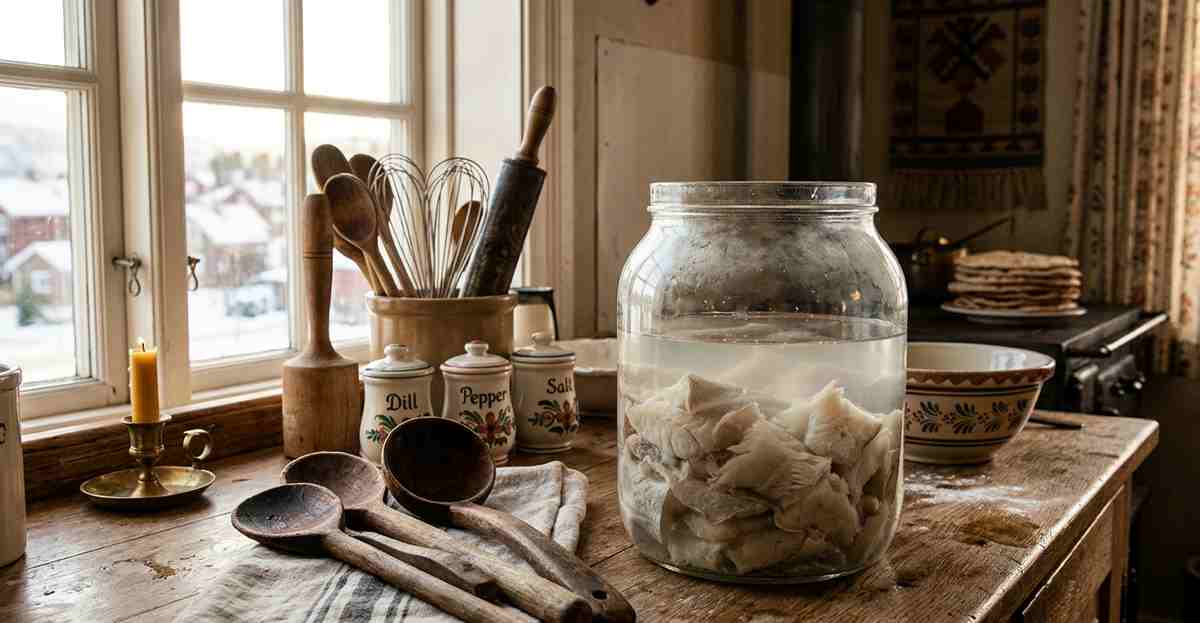
— whitefish soaking in a lye solution during the curing process.
What Does Lutefisk Taste Like?
Describing the taste of lutefisk is not easy. Many people say it has a very mild fish flavor. The texture is the most memorable part. The fish becomes soft, slippery, and jelly-like. Some people compare it to very firm Jell-O. Others say it feels like soft gelatin.
Traditionally, people serve lutefisk with specific side dishes. These include:
- Boiled potatoes
- Mashed green peas (or mushy peas)
- Crispy bacon bits
- Mustard sauce
- Flatbread or lefse (Norwegian soft flatbread)
- Melted butter
The side dishes help balance the unique texture and mild flavor of the fish. Many people also drink aquavit or beer with their lutefisk meal.
Lutefisk in Minnesota: A Scandinavian-American Tradition
Why is lutefisk Minnesota so famous? Many Norwegian immigrants settled in Minnesota during the 19th century. They brought their food traditions with them. Today, Minnesota has one of the largest Norwegian-American populations in the United States.
People usually eat lutefisk during the winter months. Many churches and community groups host lutefisk dinners. These events typically happen from November through January. The dinners are social gatherings where families celebrate their Scandinavian heritage.
Some people love lutefisk. Others eat it only out of tradition. And some people avoid it completely. But for Norwegian-Americans, lutefisk remains an important link to their ancestors.
Where to Find Lutefisk in Minnesota and Beyond
If you want to try lutefisk Minnesota, here are your best options:
Church Dinners: Many Lutheran churches in Minnesota host annual lutefisk dinners. These are usually in October, November, or December. Check local church websites for schedules.
Minneapolis-St. Paul Area: Some Scandinavian restaurants in the Twin Cities serve lutefisk during the holiday season. Examples include Fika at the American Swedish Institute. Also check Ingebretsen’s Nordic Marketplace.
Small Town Minnesota: Towns like Benson, Madison, and Milan are famous for their lutefisk dinners. These small communities celebrate their Norwegian heritage every year.
Outside Minnesota: You can also find lutefisk in other states. For example, Washington (especially Seattle and Poulsbo), Wisconsin, North Dakota, and Iowa have Norwegian-American communities.
The Lutefisk Lover’s Lifeline: As mentioned in the CNN Indonesia article, fans of lutefisk can check online resources. The “Lutefisk Lover’s Lifeline” lists restaurants and dinners serving lutefisk.
Our advice: If you want to try lutefisk, go to a church dinner. The food is homemade, and the atmosphere is welcoming. Bring a friend who has eaten it before. And remember to try it with bacon and potatoes!
For other unique American immigrant foods, read about Rocky Mountain oysters or civet coffee.
For more information on food safety and traditional preservation methods, check out WHO’s food safety guidelines.
Key Takeaways:
• Lutefisk is dried whitefish (usually cod) soaked in a lye solution, then rehydrated and cooked
• The process gives the fish a translucent, jelly-like texture and very mild fish flavor
• Norwegian immigrants brought lutefisk to Minnesota in the 19th century
• People traditionally eat it in winter with potatoes, peas, bacon, and flatbread
• Church dinners and Scandinavian restaurants serve lutefisk, especially during the holiday season
• The Lutefisk Lover’s Lifeline helps people find lutefisk dinners online
• Minnesota has one of the largest Norwegian-American populations in the US
Ready to Try This Tradition?
Follow EatSleepPush for more extreme food guides